
How to write a resume with no experience: a US guide with an example
No formal job yet? Students, recent graduates and newcomers to the US usually have more experience than they think. Here is what counts, how to write it, and a full one-page example.
Free to start · fill in a simple form · no card needed
In short: a resume with no experience is still a one-page US resume. Use a combination layout: a short summary that names your skills, then an Experience section that honestly includes volunteering, family business, side jobs and work abroad, with dates and numbers. Students put education near the top. Finish with the skills entry-level employers look for and any certificates, such as CPR or food handler training.
Last updated: · By the MyEasyCV team
“No experience” usually means “no formal US job”
Most people searching for this are students looking for a first part-time job, recent graduates, or newcomers to the US whose experience is informal or from another country. The real problem is rarely a lack of experience. It is that the experience doesn’t look like a job with a pay stub, so people leave it off.
Employers hiring for entry-level jobs know you are new. They want to see that you show up, learn fast, deal well with people and can be trusted with cash, children or customers. Helping in your family’s store or babysitting every week shows exactly that, if you write it like work.
New to US resumes? Start with our US resume format guide, and read CV vs. resume if you are not sure which document you need. This page covers what to put on the page when you have no job history.
What counts as experience on a first resume
Anything you did regularly, with responsibility, for other people counts. Give it an honest name and show what you achieved.
| Where you got it | How to list it | What to show |
|---|---|---|
| Volunteering: food banks, school events, shelters | Volunteer, Food Pantry Assistant | People served, hours, shifts, anything you organized |
| Family business: store, restaurant, farm, workshop | Your real task + “(Family Business)” | Customers, cash handled, orders, hours a week |
| Side work: babysitting, yard work, cleaning, selling food | Babysitter (Self-Employed) | Regular clients, repeat bookings, how long you did it |
| Caring for a family member | Family Caregiver | Only for care jobs: medications, appointments, meals, help with moving around |
| Church and community roles | Youth Group Leader, Event Volunteer | Group size, events organized, funds raised |
| School projects, clubs and sports | A Projects section, or a role such as Team Captain | What you built or led, team size, results |
| Work in your home country, paid or not | Like any job, with the city and country | The same results you would show for a US job |
Two honesty rules make this work. Call the section “Experience”, not “Work Experience”, so unpaid roles fit without pretending to be jobs. And put the label in the title, such as “(Family Business)” or “(Self-Employed)”, so nothing surprises the recruiter in the interview.
Which resume format to use when you have no experience
There are three common resume formats. Here is an honest comparison for a first resume.
| Format | What it looks like | For a first resume |
|---|---|---|
| Reverse-chronological | Experience first, newest to oldest, with dates | Works once your informal roles are listed with dates. It is the format recruiters are most used to. |
| Functional (skills-based) | Groups of skills instead of jobs, few or no dates | Tempting, but many recruiters distrust it because it can hide gaps or a very short history. |
| Combination | A skills-focused summary, then experience with dates | The best fit for most first resumes: skills come first, and informal work still shows dates and results. |
In practice: a three-line summary with your strongest skills, an Experience section with your informal and unpaid roles, Projects if you have any, then Skills, Education and Certifications. Students and recent graduates move Education up (see below).
Example: a first US resume for a newcomer with no formal job
Valeria is a fictional 20-year-old from Maracaibo, Venezuela. She moved to Charlotte, North Carolina, in 2023, finished advanced ESL classes, babysits for three families and volunteers at a food pantry every Saturday. She has never had a formal US job, yet her resume fills one page.
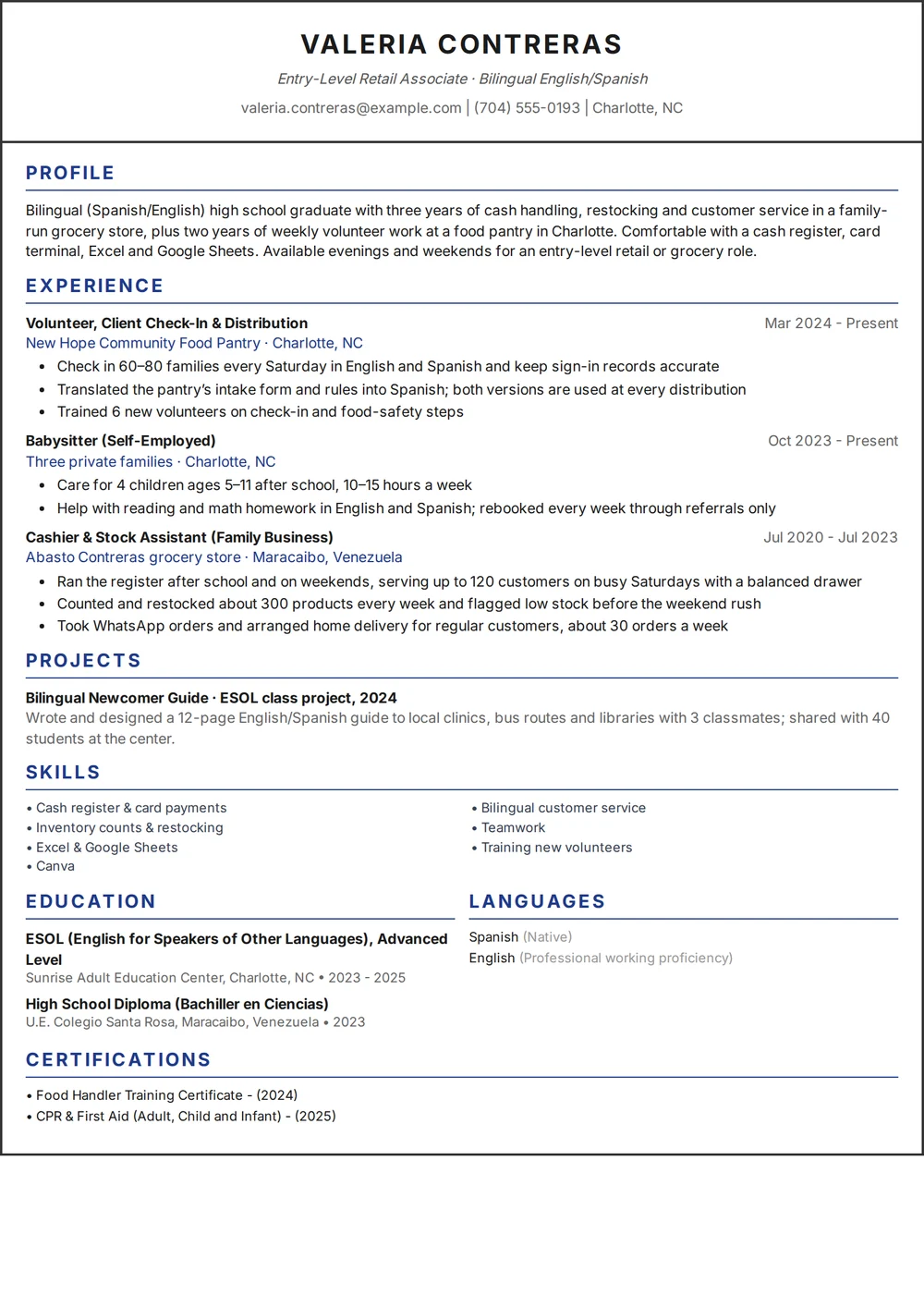
Why this resume works
- The summary does the selling. Three lines say what she has done (cash, restocking, customer service), where, for how long and when she can work: the “skills first” part of a combination resume.
- Every role is labelled honestly. Volunteer, Self-Employed and Family Business are right in the titles.
- Numbers make small jobs real. 60–80 families every Saturday, up to 120 customers on a busy day, 6 volunteers trained.
- Work abroad keeps its city and country, and being bilingual is proven, not just claimed: she translated the pantry’s intake form.
- Education comes after experience because her informal work is stronger. The Venezuelan diploma is written as a High School Diploma, with the original name in brackets.
How to write informal work as resume bullets
Use the formula of any US resume: action verb + what you did + a number or result. Past tense for finished roles, present tense for current ones, and no “I”.
| What you did | Resume bullet |
|---|---|
| Helped at my parents’ taco stand on weekends | Prepared and served food for up to 150 customers per weekend shift at a family-run food stand |
| Cleaned houses with my aunt | Cleaned 3–4 homes a day as part of a two-person team; kept every regular client for over a year |
| Took care of my grandmother | Managed the daily medication schedule and medical appointments of an elderly family member for two years |
| Volunteered at church events | Coordinated 12 volunteers for a 300-person community festival; set up and ran the registration table |
| Translated for neighbors | Interpreted English/Spanish for neighbors at school meetings and medical appointments several times a month |
No numbers? Estimate honestly with “about” or “up to”: people, hours a week, orders, events, months. A number you can explain in an interview beats “hard-working” every time.
The education section for students and recent graduates
When your work history is short, education does more of the work. Put it right after the summary if you are in school or graduated in the last year or two.
School, place and date
Write the school’s name, the city and state (or country) and your graduation date; if you are still studying, write “Expected May 2027”. Add one line of relevant courses or honors if they match the job.
GPA only if it helps
Most US schools use a 4.0 scale. Add your GPA if it is strong; if it isn’t, you can leave it out.
A diploma from another country
Write the US name first and the original in brackets: “High School Diploma (Bachiller en Ciencias), Maracaibo, Venezuela”. If a college or employer asks for a credential evaluation, ask which services they accept.
ESL, GED and short courses
ESL or ESOL classes, the GED or HiSET (the US high school equivalency tests) and short certificates belong here too. They show progress, which matters when you are new.
Skills entry-level employers in the US look for
Entry-level job ads ask for the same things again and again. Put the ones you can prove in your Skills section and back them up in your bullets.
| Skill | How to show it |
|---|---|
| Reliability and availability | Roles you kept for a long time and, if it is true, “Available evenings and weekends” in your summary |
| Customer service | Customers, families or clients served; problems solved; clients who came back |
| Cash handling and basic math | Cash register, card terminal, balanced drawer, inventory counts |
| Bilingual communication | Translating, interpreting, serving customers in two languages |
| Basic computer skills | Email, Word and Excel or Google Docs and Sheets, a point-of-sale system |
| Certificates | CPR and First Aid, food handler training (some states and counties require it for restaurant work), OSHA 10 or forklift for warehouse jobs, a driver’s license if the job needs one |
Skip personality words with no proof, such as “responsible” or “fast learner”. Aiming at jobs with customers? Our customer service resume guide goes deeper.
How to build your first resume with MyEasyCV
No CV yet? Start with the form: you type your information once, and the AI turns it into a formatted resume in the language you choose.
Step 1: Open the form
Go to the CV builder. The first tab, Fill the Form and Create CV, is already open. You’ll need to sign in or create a free account before your resume is generated.
Step 2: Add your contact details
Full Name and Email Address are required; add your phone and city too. Leave the optional profile photo empty for US jobs.
Step 3: Add every role under Work Experience
Add each role with + Add More Experience (on the resume, the section is headed “Experience”) and put the label in the Job Title, for example “Cashier (Family Business)”. In Description, list what you did on separate lines, with your numbers:
Description field, example
Check in 60–80 families every Saturday in English and Spanish
Translated the intake form into Spanish
Trained 6 new volunteersStep 4: Fill in education, skills and extras
Then fill in Education, Technical Skills, Soft Skills and Languages You Speak. The optional Additional Information section has room for certifications, courses and school projects.
Step 5: Choose English and a single-column design
In CV Language, choose English; you can still type your details in Spanish. Pick a single-column design such as Classic and click Generate My CV. The AI uses only what you entered: it can polish the wording, but it won’t invent achievements, so the numbers have to come from you.
Step 6: Check it and download it
Fix anything with Edit CV, which is free and unlimited. Your resume is saved under My CVs. The free PDF has a watermark; the clean PDF needs the One-Time package or the Pro plan, and prices depend on your country.
MyEasyCV creates A4 PDFs; if you print one in the US, choose “Fit to page” for Letter paper. Already have a CV from school or your home country? Upload it instead.
Mistakes to avoid on a resume with no experience
- Writing “No experience” or leaving the Experience section empty. If you have done anything from the table above, you have experience.
- Opening with an objective such as “Seeking a position where I can grow”. Say what you can do for the employer instead.
- Hiding work from your home country or from the family business because it was unpaid or informal.
- Dressing up a role: calling yourself “Store Manager” when you helped at your parents’ shop. Recruiters ask, and the title has to match your story.
Frequently asked questions
Can I write a resume with no work experience at all?
Yes. Use a summary, an Experience section with volunteering, family business, side jobs or school projects, then education, skills and any certificates. For entry-level jobs, employers expect a short history and look for reliability and a willingness to learn.
Does volunteer work count as experience?
Yes. List it under Experience with “Volunteer” in the title, plus the organization, the dates and what you achieved. It is real experience with real responsibility; it just wasn’t paid.
How do I list work in my family’s business?
Use your real task as the title and add “(Family Business)”, for example “Cashier & Stock Assistant (Family Business)”. Then describe it with numbers like any other job: customers, orders, products, hours a week.
What should a student put on a first resume?
Education first: school, expected graduation date, relevant courses and honors. Then projects, clubs, sports, volunteering and any part-time or summer work, followed by skills.
Do I need to include references?
Not on the resume. Have two or three names ready in case the employer asks: a teacher, a volunteer coordinator or a family you babysat for.
Ready to write your first resume?
Fill in the form with your volunteering, family business, side jobs and school projects, and turn them into a one-page US resume in English.