
CV vs resume: what’s the difference, and which one should you send?
In the US, a CV and a resume are two different documents. In the UK, Europe and Latin America, “CV” usually means what Americans call a resume. Here is how to tell which one an employer wants, and how to turn one into the other.
Free to start · upload PDF, DOC or DOCX · no card needed
In short: in the US and Canada, a resume is the one- to two-page document you send for almost every job, and a CV (curriculum vitae) is a long, complete record of an academic career: publications, teaching, grants and presentations. In the UK, Europe and Latin America, “CV” is simply the normal job document, much closer to a US resume. If a US employer outside academia asks for a CV, send a resume.
Last updated: · By the MyEasyCV team
The difference between a CV and a resume
Both documents cover your education and your work; the difference is purpose and length. A resume is a selection: the experience that fits one kind of job, on a page or two. An academic CV is a complete record of everything you have published, taught, presented and been funded for, and it grows every year.
Curriculum vitae is Latin for “the course of life”; résumé is French for “summary”. What each word means depends on the country, as the table below shows. For the rules of the US format itself, see our US resume format guide.
What “CV” means depends on the country
This is the general pattern. A single employer or university can ask for something else, so always follow the job ad.
| Where you apply | What “CV” means there | What to send for a regular job |
|---|---|---|
| United States | A long academic CV: research, publications, teaching, grants | A resume of one page, two at most |
| Canada | Mostly the academic CV, as in the US | A resume of one or two pages |
| UK and Ireland | The standard job document | A CV, usually about two pages |
| Spain and the rest of Europe | The standard job document (Spain: currículum; the EU also offers the Europass CV) | A CV in the local format |
| Latin America | The standard job document: currículum, CV or, in Colombia, hoja de vida | A CV in the local format |
| Much of Asia, the Middle East and Africa | Both words are common and often name the same document | Whatever the ad asks for |
What goes into a US academic CV
An American academic CV has no page limit. It usually contains these sections:
Education
Degrees from newest to oldest; for a PhD, the dissertation title and advisor. Many academics list it first.
Research positions
Postdocs, faculty posts and assistantships, described by research topic.
Publications and presentations
Every paper, preprint, talk and poster, cited in full in your field’s style.
Grants and awards
Fellowships, scholarships and funding you won or helped win, with the funder and dates.
Teaching, mentoring and service
Courses, guest lectures, students you supervised, peer review, committees and outreach.
References
Usually three names with contact details, often your advisors. A resume leaves them off.
You need one for faculty and postdoc jobs, many fellowships, some graduate programs and most physician jobs. Many US research funders, though, want a short biographical sketch in their own format instead of your full CV.
Academic CV vs resume in the US, side by side
| — | Academic CV | Resume |
|---|---|---|
| Purpose | A full record of your academic work | A case for one kind of job |
| Length | No limit; grows over a career | One page; two with long relevant experience |
| First reader | A search committee in your field | A recruiter, often after an applicant tracking system |
| Opening | Contact details; often no summary | A three- or four-line summary aimed at the job |
| Publications | Every one, with full citations | One line, or a few selected papers |
| Experience | Positions and research topics | Achievements with numbers |
| Teaching and service | Sections of their own | One training or leadership bullet, or nothing |
Which one should you send?
Go by the job, not by the word:
| If you are applying for… | Send | Why |
|---|---|---|
| A faculty, postdoc or research post at a US university | Academic CV | The committee wants your full record. |
| A US industry job, including R&D | Resume | One page, or two for a PhD with relevant experience. |
| A non-academic US job whose ad says “CV” | Resume | Many US employers say “CV” and mean a resume. |
| An online form with a “CV/Resume” field | The document that fits the job | Academic post: CV. Anything else: resume. |
Example: one researcher, two documents
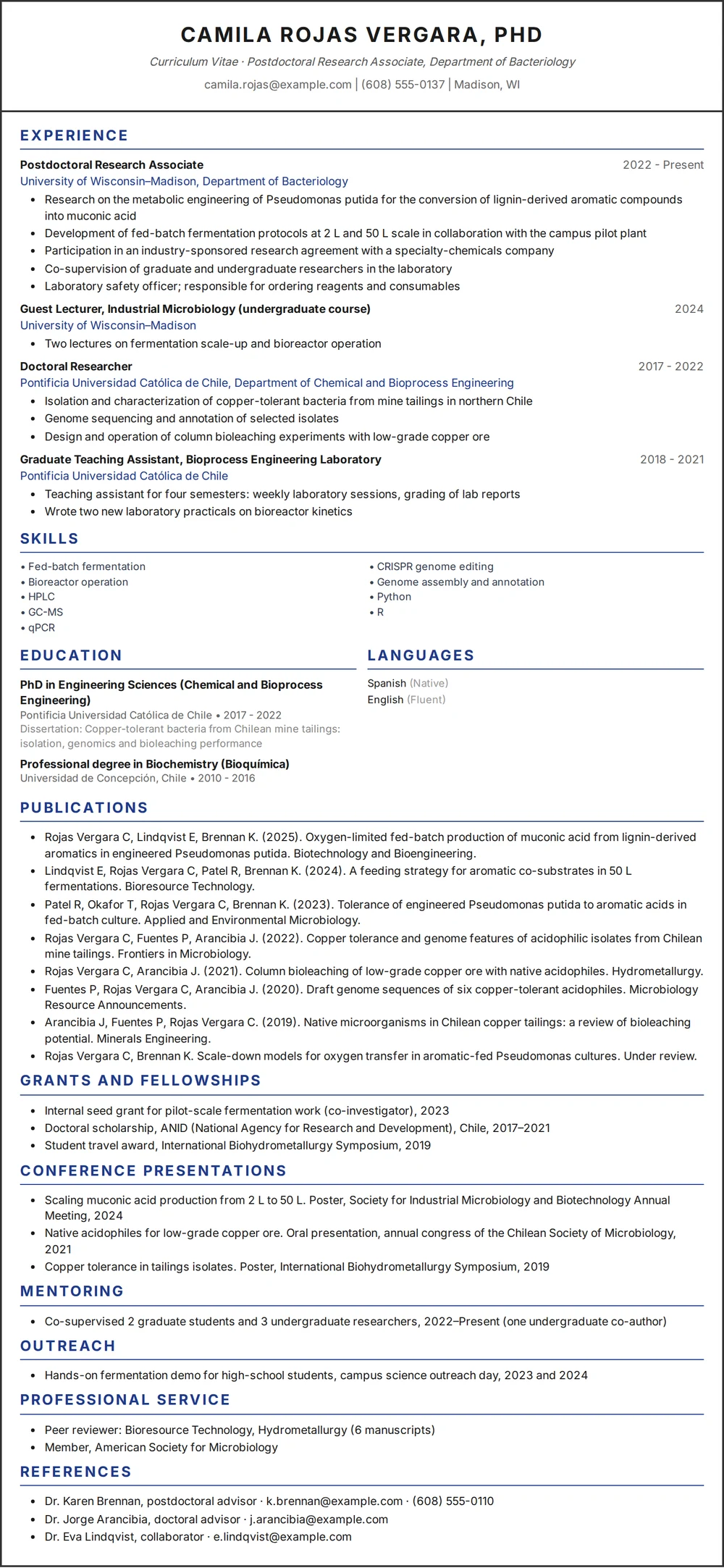
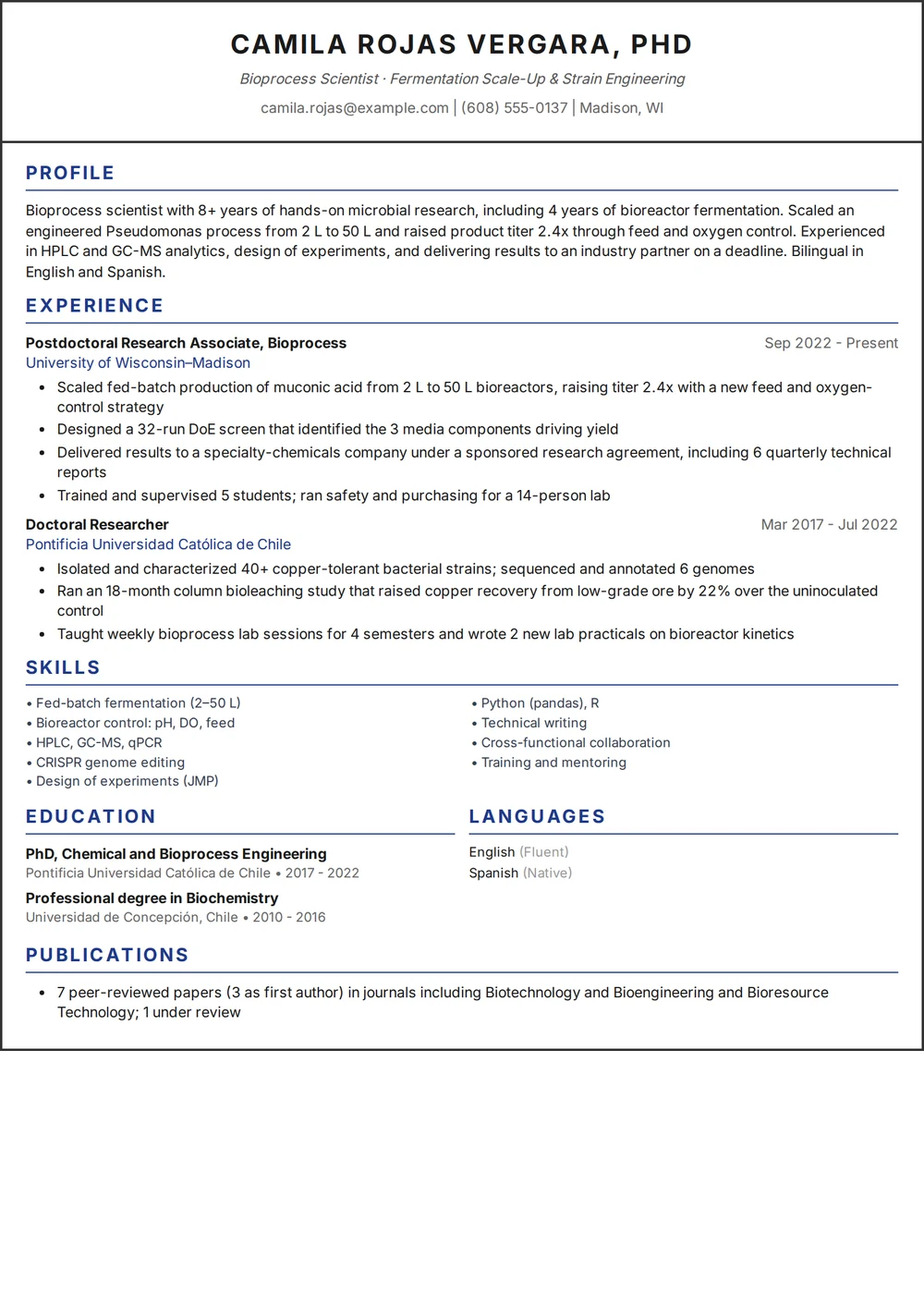
Camila is a fictional Chilean microbiologist, a postdoc at a US university who wants a bioprocess job in biotech. On the left is her academic CV; on the right, the industry resume she made from it. Both use the same MyEasyCV design, Classic, so only content and length change.
What changed, and why
- A target title and a summary. “Curriculum Vitae · Postdoctoral Research Associate …” became “Bioprocess Scientist”, the job she wants, followed by a summary with her years of experience, best result and tools.
- Topics became results. “Development of fed-batch fermentation protocols at 2 L and 50 L scale” became “Scaled fed-batch production … from 2 L to 50 L bioreactors, raising titer 2.4x”. The 2.4x was never on the CV.
- Industry experience moved forward. “Participation in an industry-sponsored research agreement” became a bullet about six quarterly technical reports delivered to a company, exactly what an industry recruiter looks for.
- Four positions became two. Teaching became one bullet, mentoring became “Trained and supervised 5 students”, and the guest lectures went.
- Eight citations became one line, and grants, presentations, outreach, service, references and the dissertation title came off. They matter to a search committee, not to a recruiter.
- Skills got specific. “Bioreactor operation” became “Bioreactor control: pH, DO, feed”, the words bioprocess job ads use.
How to turn an academic CV into an industry resume
Leaving academia is mostly translation: the same work, described for a reader outside your field.
Step 1: Pick the job first
Choose one target title and read five to ten real ads for it. Your resume should use the skills and words they repeat.
Step 2: Write a summary for that job
Three or four lines: what you are now (“Bioprocess scientist”, not “Postdoc”), years of hands-on experience, one or two results with numbers and your main tools.
Step 3: Turn each position into results
Ask what you built, improved or delivered, and by how much. Write three to five bullets per job, each starting with a verb.
Step 4: Shrink the academic sections
Publications go down to one line or a few selected papers. Presentations, grants and service usually go, teaching and mentoring become a training bullet, and references come off.
Step 5: Cut to one or two pages
Two pages are fine for many scientist roles, as long as every line on page two matters for the job.
Step 6: Check the US format
Contact line, dates, no personal details: our US resume format guide covers the conventions.
From academic phrasing to resume phrasing
Same work, different words. Examples from Camila’s CV and from other fields:
| On the academic CV | On the resume |
|---|---|
| Research on the metabolic engineering of Pseudomonas putida for muconic acid production | Engineered a strain and fermentation process that raised product titer 2.4x at 50 L scale |
| Co-supervision of graduate and undergraduate researchers | Trained and supervised 5 students; one became a co-author |
| Dissertation: statistical models of rainfall variability in the Andes | Built forecasting models in R and Python on 30 years of weather data |
| Conducted 40 semi-structured interviews (qualitative study) | Ran 40 one-on-one interviews and summarized the findings for decision-makers |
Going the other way: from resume to academic CV
Applying for a PhD, research or teaching post in the US? Expanding a resume into a CV is mostly adding:
- Add your thesis title and advisor to Education, and consider moving it to the top, as many academics do.
- Add Publications with full citations, including work under review, in one consistent style.
- Add Presentations, Grants and awards, Teaching and Service, even if each has only one line.
- Replace the sales-style summary with a short “Research interests” line, or leave it out.
- Don’t cut for length: a missing publication costs more than an extra page.
How to shorten your CV into a resume with MyEasyCV
MyEasyCV can rewrite and lay out a resume from the CV you already have, in English or another language. Two facts matter here: you can upload up to 5 pages, and the AI keeps all the content you upload on purpose, so the cutting is up to you.
Step 1: Make a short copy of your CV
Delete what the resume won’t need, such as the full publication list, presentations, grants and references. This also keeps a long CV within the 5-page limit.
Step 2: Upload it
Open the CV builder in upload mode, sign in or create a free account, and upload a PDF, DOC, DOCX or TXT file.
Step 3: Say what you want
Write your instructions in Additional Notes, one per line; they go to the AI with your file. For example:
Additional Notes, example
Write this as a US industry resume for Bioprocess Scientist jobs.
Rewrite each research position as achievements that start with an action verb.
Keep all my numbers and dates.Step 4: Choose English and a single-column design
Pick English in CV Language, choose one of the 11 single-column designs, such as Classic, and click Generate My CV. It usually takes about a minute, and the page count is set automatically.
Step 5: Edit and download
Delete anything still too academic with Edit CV, which is free and unlimited; a free account also has 3 AI edits. Your resume is saved under My CVs. The free PDF has a watermark; a clean PDF needs the One-Time package or the Pro plan, and prices depend on your country.
Frequently asked questions
What does CV stand for?
Curriculum vitae, Latin for “the course of life”. In the US it means the long academic document; in the UK, Europe and Latin America it is the everyday word for the document you send with a job application.
Can I send a CV instead of a resume for a US job?
For academic, research and medical posts, yes. For other jobs, send a resume: a three-page CV tends to look unfocused to an industry recruiter, even when the experience behind it is strong.
Should a PhD list publications on an industry resume?
Briefly: one line with the number of peer-reviewed papers, or two or three selected papers that match the job, plus a link to your Google Scholar or ORCID profile.
Is a CV from the UK, Europe or Latin America a resume?
In practice, yes. It is the standard job document there and much closer to a US resume than to an academic CV, but it still needs adapting to US conventions before you send it to an American employer.
Can MyEasyCV turn my academic CV into a resume?
Yes, with your help. Upload a shortened copy (up to 5 pages) and ask for an industry resume in Additional Notes. The AI keeps everything you upload, so remove extra sections before uploading or afterwards in the free editor. Your first CV is free to create with an account.
Ready to turn your CV into a resume?
Upload the CV you have, tell the AI which job you’re aiming for, and edit the result into a focused resume of one or two pages.