
Caregiver resume: how to write one for US home care jobs
Most caregiving happens inside private homes, often for families who hired you directly. Here is how to put that work on a US resume honestly, which details home care employers look for, and a complete example.
Free to start · upload PDF, DOC, DOCX or TXT · no card needed
In short: a caregiver resume is a one-page US resume that proves you can be trusted with a person and a home. List family jobs as “Private Household” with the city and state, give each job its scope (the client’s age and condition, hours per week, live-in or live-out) and your exact duties, write “medication reminders” if that is what you did, and list CPR/First Aid under Certifications. Keep references off the page, but have two or three ready.
Last updated: · By the MyEasyCV team
What home care employers look for in a caregiver resume
Home care and home health agencies, assisted living facilities and private families all read a caregiver resume for the same answers: what care you have given, to whom, for how long, and who can confirm it.
This guide covers care for adults and older people: home health aides (HHA), personal care aides (PCA), companions and private or live-in caregivers. A nanny resume follows the same private-family rules but needs different duties and training, so childcare is not covered here.
Each job on your resume should answer four questions:
- Who: the client’s age range and condition (dementia, stroke recovery, limited mobility), never their name.
- How much: hours per week, live-in or live-out, night shifts, years.
- What exactly: bathing, dressing, toileting, transfers, meals, medication reminders, appointments.
- Proof: dated certifications, a driver’s license if the job needs one, references ready to call.
Caregiver resume example: private households in New Jersey
Lourdes is a fictional caregiver from San Pedro Sula, Honduras. She worked there as a hospital nursing assistant and, since 2019, has cared for older adults in private homes in New Jersey, hired directly by the families.
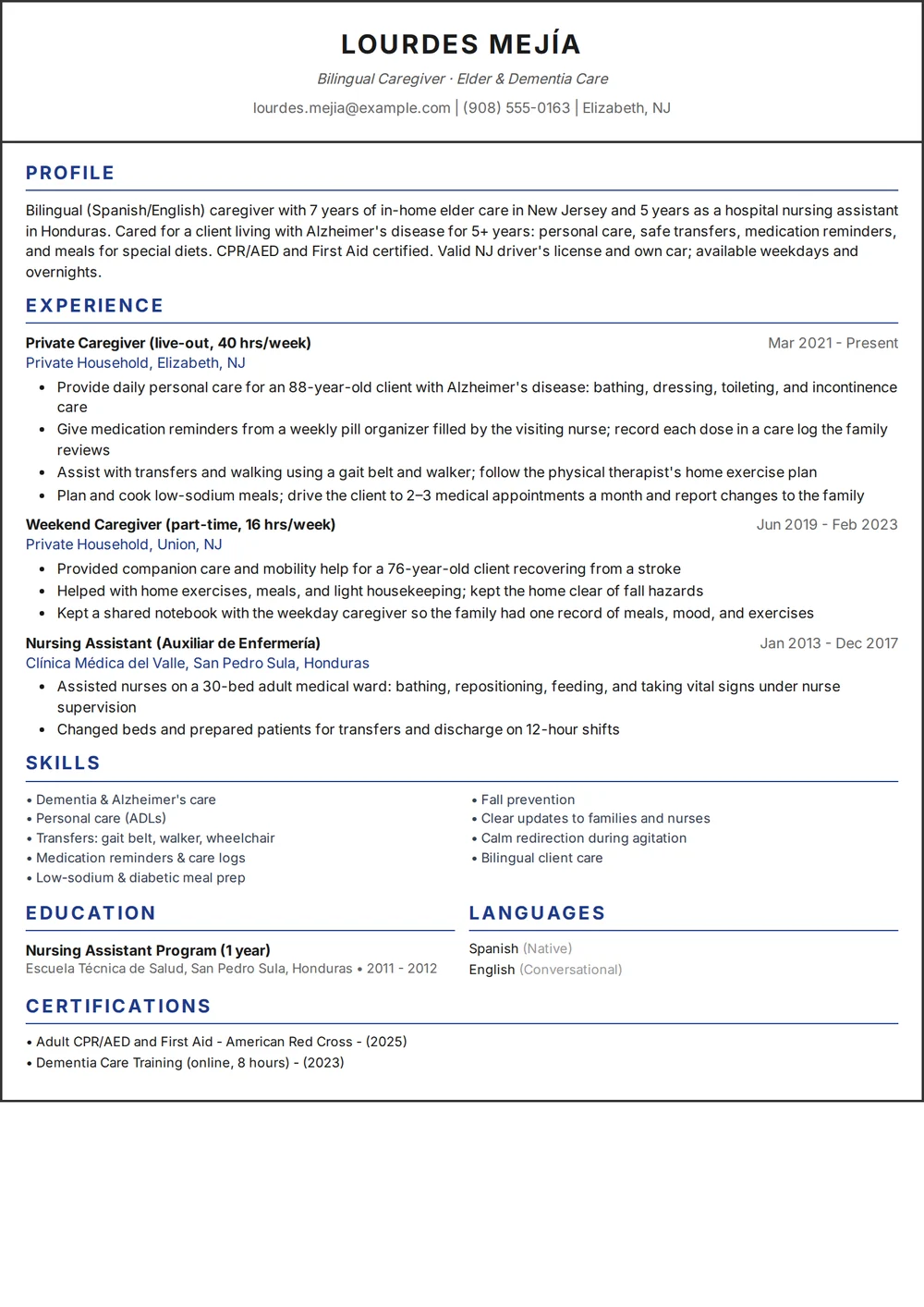
Why this resume works
- Honest employer lines. Both US jobs say “Private Household” with the town: no invented company, no client name.
- Scope in the job title. “Live-out, 40 hrs/week” and “part-time, 16 hrs/week” show at a glance how much care she has given.
- Real dates, even when jobs overlap. For two years she worked weekdays for one family and weekends for another, and both entries say so.
- Exact medication wording. She reminded her client to take doses from a pill organizer the nurse filled. The resume doesn’t claim she administered medication.
- Experience from Honduras counts. Her hospital years show hands-on skills, and the title keeps the Spanish term instead of claiming a US certification.
How to list private and family-employer jobs
Many caregivers are hired directly by a family, paid by the hour, sometimes in cash, with no company name anywhere. That is still work experience, as long as you describe it truthfully and someone can confirm it.
| Your situation | Employer line on the resume | Notes |
|---|---|---|
| Hired directly by one family | Private Household, Elizabeth, NJ | The most common choice. “Private Family” works too. |
| The family agrees to be named and to give a reference | Miller Family (private household), Montclair, NJ | Only with their permission. Never the client’s full name or address. |
| Several families at once | Self-Employed Caregiver, Multiple Private Households, Union County, NJ | One entry; describe the clients in the bullets, e.g. “3 clients, 10–20 hrs/week each”. |
| Hired and paid by an agency | The agency’s name and city | The agency is your employer. Don’t name the client. |
| Found the family through an online platform | Private Household, City, ST | If a company paid you and set your shifts, list that company instead. |
| Cared for your own relative without pay | Family Caregiver (unpaid), City, ST | Real experience if you describe it honestly; see resume with no experience. |
Paid in cash? List the job the same way. Don’t invent a company, a title or dates: home care employers commonly run background checks and call references, and a mismatch costs you more than a modest title.
Protect your client’s privacy. Age range and condition are enough (“an 88-year-old client with Alzheimer’s disease”); leave out anything that could identify them.
Turn care tasks into bullets with scope
A family might sum up your work as “she took care of my mother”. A recruiter needs to know for whom, how much and exactly what. Start each bullet with a verb, then add the condition, the hours or frequency, and the equipment. In caregiving, your numbers are hours, years, clients and shifts, not percentages.
| Vague | Specific, with scope |
|---|---|
| Took care of an elderly lady | Provided personal care 40 hrs/week for an 88-year-old client with Alzheimer’s disease: bathing, dressing, toileting |
| Gave her the medicines | Gave medication reminders from a pill organizer filled by the visiting nurse; logged every dose |
| Helped him walk | Assisted with transfers and walking using a gait belt and walker; followed the physical therapist’s exercise plan |
| Did night shifts | Covered overnight shifts 3 nights a week: repositioning every 2 hours and help with toileting |
Reminders, assistance or administration?
Reminding a client to take a pill, helping them open the bottle and giving the medication yourself are three different tasks, and who may do which depends on the state and the type of employer. Write what you actually did, and say so if a nurse or the family prepared the medication.
Certifications and training: what to list
Requirements depend on your state and on who hires you: an agency, a facility and a private family can ask for different things. Read the job ad and check your state’s official rules before you pay for a course.
CPR and First Aid
Many caregiver ads ask for it. Write the course name, provider and year, for example “Adult CPR/AED and First Aid, American Red Cross, 2025”, and renew it before it expires.
Home health aide (HHA)
Home health agencies often require HHA training or certification, and the rules differ by state. List it with the state and the year, exactly as on your certificate.
Certified nursing assistant (CNA)
This is a state certification: write it only if you hold it in a US state. Trained abroad? Write “Nursing Assistant Program (Honduras)” or your country, and see our nurse resume guide for nursing roles.
Other courses
Personal care aide (PCA), dementia care or safe transfer training, with the hours or the provider. Still in a course? Write “expected” and the month.
Driver’s license
If the job involves driving a client, add “Valid NJ driver’s license; own car” (with your state) to your summary. Mention a clean driving record only if it is true.
Spanish caregiving terms and honest US wording
If your experience is from Latin America, or you simply think about your work in Spanish, use these equivalents. Pick the term that matches what you really did, not the one that sounds most impressive.
| In Spanish | On a US resume | Note |
|---|---|---|
| Cuidadora de adulto mayor | Caregiver · Elder Caregiver · Senior Caregiver | Use the title the job ad uses. |
| Cuidadora interna, cama adentro | Live-in Caregiver | Add the days per week you lived in. |
| Dama de compañía, acompañante | Companion Caregiver | If you also bathed or dressed the client, say so. |
| Auxiliar de enfermería | Nursing Assistant (Honduras) | Add your country. CNA only with a US state certification. |
| Técnica en enfermería (Perú) | Nursing Technician (Peru) | “RN” or “nurse” only with a US nursing license. |
| Aseo personal, higiene | Personal care: bathing, grooming, toileting | Ads often call these “ADLs” (activities of daily living). |
| Cambio de pañal | Incontinence care | The respectful term in adult care. |
| Movilización, traslados | Transfers and mobility assistance | Name the equipment: gait belt, walker, Hoyer lift. |
| Dar los medicamentos | Medication reminders · assistance with medication | “Administered” only if you did it and were allowed to. |
Skills, languages and references
Skills a recruiter can search for
Dementia care, transfers, incontinence care, special-diet meals, care logs, fall prevention, availability for nights or live-in work. Skip “patient” and “loving”; your bullets prove them.
Languages
Being bilingual in Spanish and English is a real advantage with many clients and families. Rate your English honestly, for example Conversational or Fluent; the interview will show your level anyway.
References: have them ready
In caregiving, references carry a lot of weight. Keep them off the resume, but prepare a separate page with two or three people (families you worked for, a nurse or a supervisor), their phone numbers and how they know you. Ask each person first, and mention it if one speaks only Spanish.
How to make your caregiver resume with MyEasyCV
Upload a CV you already have, in English or Spanish. No CV at all? A plain list of your jobs in a Word or TXT file is enough to start.
Step 1: Upload your CV or a list of your jobs
Open the CV builder in upload mode and sign in or create a free account. Upload a PDF, DOC, DOCX or TXT file (up to 5 pages): an old CV, or a list with each family or employer, the dates, the hours and your duties. Prefer a form? Start from scratch.
Step 2: Tell the AI how to describe your work
Under the file, write your instructions in Additional Notes, one per line; they are sent to the AI with your file. For example:
Additional Notes, example
Write it as a US caregiver resume in American English.
List my jobs with families as "Private Household" with the city and state.
Write "medication reminders", not "administered medication".
Keep my nursing assistant training from Honduras, but do not call it CNA.Step 3: Choose English and a single-column design
In CV Language, choose English. Pick one of the 11 single-column designs, such as Classic, and click Generate My CV. It usually takes about a minute.
Step 4: Check names and wording
The AI keeps everything you uploaded, including people’s names. Replace any family or client name with “Private Household” in Edit CV, which is free and unlimited, and check every medication line.
Step 5: Download it
Your resume is saved under My CVs. You can download a free PDF with a watermark; the clean PDF needs the One-Time package or the Pro plan, and prices depend on your country.
MyEasyCV creates A4 PDFs. Online applications accept them as they are; if you print one in the US for an interview, choose “Fit to page” for Letter paper.
Frequently asked questions
How do I list private caregiving jobs on my resume?
Write “Private Household” with the city and state as the employer, your real title and dates, and bullets with the client’s age and condition, your hours and your exact duties. Don’t invent a company name.
What certifications do I need to work as a caregiver in the US?
It depends on your state and on who hires you. CPR and First Aid are widely requested, home health agencies often ask for HHA training, and some jobs need a state CNA certification. Check the job ad and your state’s official rules.
Should references go on a caregiver resume?
No. Keep two or three references on a separate page, ready when you apply, and ask each person for permission first.
Is “auxiliar de enfermería” the same as a CNA?
No. CNA is a certification issued by a US state. Write “Nursing Assistant” with the country where you trained, and add CNA only once you earn the state certification.
Can MyEasyCV turn my Spanish CV into an English caregiver resume?
Yes. Upload your CV or a list of your jobs, choose English as the CV language and use Additional Notes to ask for a US caregiver resume. Then check names and medication wording in the free editor. Your first CV is free to create with an account.
Ready to write your caregiver resume?
Upload your CV or a simple list of your jobs and turn it into a one-page US resume in English.